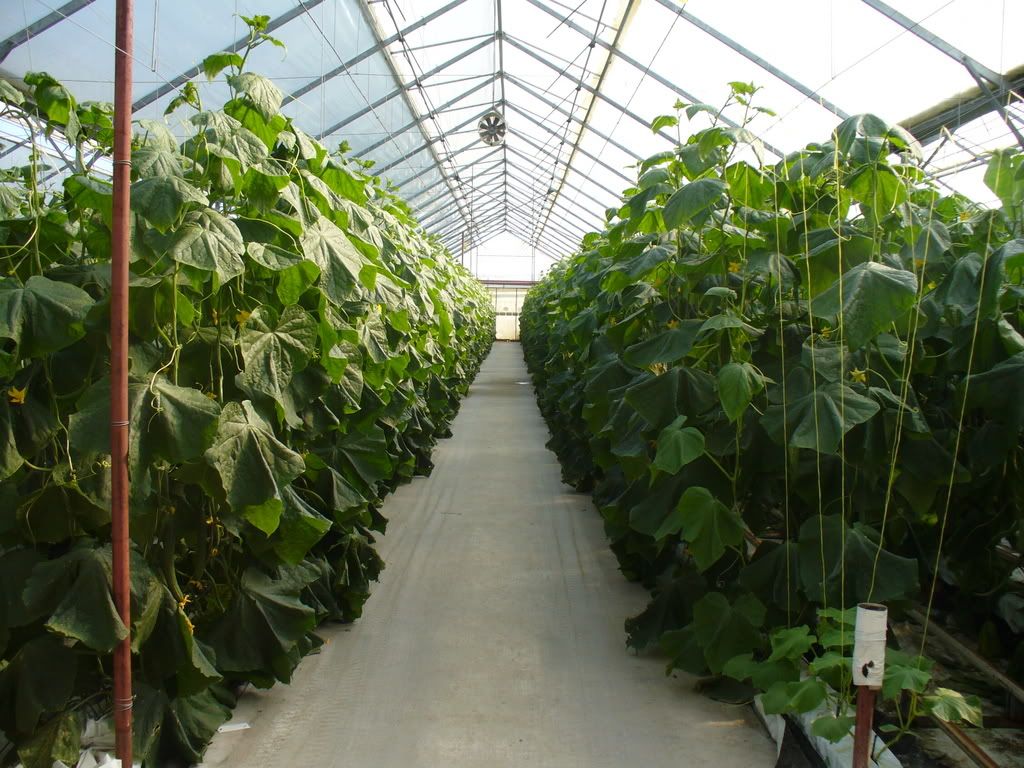
Importance: The rate of photosynthesis is dependent upon the availability of carbon dioxide. Carbon dioxide enrichment is most important during the winter months in the morning. The sun has risen and photosynthesis has begun. The plants can reduce the levels of carbon dioxide from the ambient level of about 330 ppm (higher in cities due to industry and vehicles) to around 220 ppm. Lowered carbon dioxide levels will reduce growth and can cause flower and fruit drop reducing overall yields. *Ways of controlling carbon dioxide levels in the greenhouse:
Ventilating (bringing air in from the outside) may provide sufficient carbon dioxide during the Spring, Summer and Fall months.
Ventilating during the Winter months, or anytime in cold climates, will, however, result in cold outside air being brought into the greenhouse. Heating will then be needed to maintain the proper temperature which may become uneconomical. Therefore, carbon dioxide generation is a typical and effective way to increase levels in the greenhouse during the Winter or in cold climates.
Carbon dioxide generators can burn various types of fuel including natural gas (most economical)or propane. Carbon dioxide levels above 800 ppm, even as high as 1200 ppm, have been shown to be beneficial to plant growth.
Kepentingan: Suhu yang terlalu tinggi boleh menjejaskan pertumbuhan tanaman. Ia boleh mengakibatkan masalah2 berikut:
Batang yang kurus teutamanya pada pangkal tangkai tanaman tomato
Mengurangkan saiz bunga terutamanya pada tanaman tomato yang menghasilkan bunga bercantum & pembentukan bengkak
Melambatkan proses pembungaan dan/atau pendebungaan yang tidak berkesan untuk menghasilkan buah.
Kemusnahan bunga/putik buah
Keperluan Penyejukan & Pengiraannya - 8 kaki persegi untuk setiap minit/kaki persegi bagi keluasan lantai rumah atau jumlah 1 lot rumah dibanding dengan kepanasan cuaca setiap minit. CFM = (tinggi X lebar X panjang) Contoh, Jumlah kawasan bawah + jumlah ruang persegi atap, (8 X 24 X 48) + (6/2 X 24 X 48) = 9216 + 3456 = 12,672 kaki persegi/min (saiz kipas mengikut ruang kawasan ini).
Pengudaraan Pasif:
Teduhan - Jaring peneduh atau cat putih khas mengawal kadar kecerahan sinaran cahaya (light intensity) yang terlalu terik dan mengurangkan kepanasan
Ruang Rabung Terbuka - Rabung atap yang terbuka bertujuan untuk melepaskan kepanasan/angin panas dari dalam. Kawasannya mestilah 25% dari ruang lantai.
Dinding yang digulung ke dalam - Ia bertujuan untuk melepaskan udara panas dari arah tepi
Menara penyejuk - Lapik basah yang dingin di bahagian atas menara menyejukkan udara sekitar
Atap boleh buka - Rekabentuk terbaru membolehkan atap dibuka sepenuhnya untuk membolehkan pengudaraan semulajadi
Sistem Penyejukan Aktif:
Kipas & pelapik basah - 'Penyejukan Sejatan' di mana udara dari luar disedut melalui lapik basah yang mudah menyerap (selalunya kertas selulosa). Kepanasan dari udara akan menyejatkan air dari pelapik itu dan meningkatkan kelembapan relatif di rumah lindungan.
Sistem Semburan Kabus - Menggunakan penyejukan sejat/sedut tetapi menggunapakai titisan air halus yang menyejat dan menyedut kepanasan dari udara. Sistem ini lebih merata kerana kabus air dilepaskan di sekitar rumah dan bukannya dilepaskan berhampiran dengan pelapik basah dengan kipas. Lebih kecil saiz titisan air, lebih cepat ia tersejat dan lebih cepat proses penyejukkan. Ukurlilit titisan kabus air yang efektif = 1000 miro-meter
Alat Hawa Dingin - Terlalu mahal untuk rumah lindungan secara komersial
Importance: High temperatures can be detrimental to plant growth. High temperatures can cause such problems as
Thin, weak stems or, as in tomatoes, stick trusses (thin, weak truss stems)
Reduced flower size or, as in tomatoes, flower fusion and boat formation
Delayed flowering and/or poor pollination/fertilization and fruit set
Flower and bud/fruit abortion
*Cooling requirements and calculations: The National Greenhouse Manufacturer’s Association 1993 standards = 8 cubic feet per minute/square feet of greenhouse floor area OR… 1 full greenhouse volume exchanged per minute in warm climates. CFM = height x width x length (i.e., volume) Example: Using the greenhouse dimensions in the heat calculation example: CFM = volume lower section + volume triangular top = (8 x 24 x 48) + (6/2 x 24 x 48) = 9216 + 3456 = 12,672 cubic feet per minute => size fans/pads accordingly
*Passive ventilation systems:
Shading: Shade cloth or shade paint/white wash, besides regulating the light intensity, can also help cool the greenhouse.
Ridge Vents: Vents in the roof of a greenhouse that allow hot, interior air to escape. The area of the vents should be 25% of the floor area.
Roll-up Side Walls: Can be used in flexible glazing (polyethelene film) single bay greenhouses where the side walls can be rolled up several feet allowing a natural horizontal flow of air over the plants. As with ridge vents, the area of the side wall vents should be 25% of the floor area.
Cooling Towers: Water cooled pads at the top part of tall towers cool the surrounding air which then drops displacing warmer air below.
Removable Roof: Recent greenhouse designs can include a roof that retracts completely for natural ventilation. This would allow for adaptation of greenhouse grown plants to outside conditions prior to movement outside.
*Active cooling systems:
Fan and Pad: “Evaporative cooling” where air from the outside is pulled through porous, wet pads (usually cellulose paper). Heat from the incoming air evaporates water from the pads, thereby cooling the air. Evaporative cooling will also help to increase the relative humidity in the greenhouse.
Fogging Systems: Uses evaporative cooling like the fan and pad but incorporates a dispersion of water droplets that evaporate and extract heat from the air. This system gives better uniformity since the fogging is distributed throughout the greenhouse and not just near one a pad end as with the fan and pad system. The smaller the droplet size, the faster each droplet evaporates and therefore the faster the cooling. Mist droplets = 1000 microns in diameter.
Air Conditioning: Too expensive for most greenhouses
Importance: Each plant species has an optimum temperature range. Heating devices will maintain the temperature within that range during periods of cold weather. *Types of heat loss from a greenhouse:
Conduction = Heat transfer either through an object or between objects in contact. Conduction depends on area, path length, temperature differential and physical properties of the object(s). Example: Heat loss through the glazing material on the greenhouse.
Convection = Heat transfer by the movement of warm gas or liquid to a colder location. Convection depends on temperature differential. Example: Movement of warm air near the plants upward toward the roof.
Radiation = Heat transfer between separated objects. Radiation occurs from all objects and depends on the areas, temperatures and surface characteristics of the objects involved. Example: Heat transfer from all objects in the greenhouse.
It is important to be able to estimate the heat loss from the greenhouse in order to choose the correct size of heater to replace that heat. Although radiation and convection transfer heat around the greenhouse, the main type of heat loss from a greenhouse is through conduction, i.e., the heat loss through the glazing material. *The basic system: Consists of a fuel burner, heat exchanger, distribution system and controls. Heat delivery to the crop is by convection and radiation. The fuel = usually burn natural gas, but can also use oil, coal, wood, etc.
Heating by hot water or steam: Hot water or steam can be produced using boilers fired by natural gas, etc. The hot water or steam is then transported throughout the greenhouse in pipes. The pipes can end in a heat exchanger where a fan distributes heated air. The pipes can run along the floor and also be used as cart rails between aisles. Heat will then rise upward through the crop by convection. Heat pipes can also be positioned within the crop to steer plant growth . Heated tubes can create “bottom heat” for propagation or growing.
Heating by hot air: Fuel is burned to heat air that is then distributed by fans around the greenhouse. Horizontal air flow (HAF) fans circulate warm air above the crop. Fan jet systems, with unit heaters or heat exchangers and perforated polyethylene tubes, distribute warm air and improve air movement and ventilation throughout the greenhouse.
Moveable nighttime insulation: Insulating material (cloth or film curtains) can be positioned above the crop or near the roof to retain heat near the crop. The insulating material used during the night can be the same material used for shading during the day.
Those are called dual fin heating tubes. The hot water from the boilers enters into these tubes, which radiate the heat out towards the plants
Bahan-bahan tang digunakan sebagai penutup/bumbung struktur rumah lindungan/rumah hijau boleh jadi tetap atau boleh diubah-ubah, 2 lapis atau selapis, licin atau beralun. Kebanyakan bahan pengilat yang dihasilkan sekarang ini menggunapakai bahan yang menghalang kesan buruk dari sinaran UV. Walaubagaimanapun, kesan bahan pengilat ini akan semakin haus dan diukur dari kadar jumlah tahun ia digunakan untuk membenarkan jumlah sinaran cahaya melepasinya. Antara bahan-bahan yang boleh digunakan termasuklah:
Kaca - Ia telah lama digunakan (1 abad) di Eropah Utara. 'Rumah Kaca' memerlukan jumlah kayu yang cukup banyak untuk menampung berat kepingan-kepingan kaca. Ia lebih tahan lama (25 tahun) dan menyalurkan cahaya dengan lebih berkesan. Kadar PAR (Penembusan Cahaya) ialah 71% - 92%. Namun ia sangat mahal, berat dan mudah pecah. Kebanyakkan pengusaha sekarang ini lebih memilih bahan Polimer (plastik).
Polyethylene: Ia dihasilkan di England pada 1938. Ia lebih fleksibel & ringan serta sering digunakan di rumah hijau yang berbentuk separuh bulat, melengkung dan berbentuk pintu gerbang. Kadar PAR ialah 85% - 87%. Namun begitu, jangka hayatnya hanya 2-4 tahun bergantung kepada lokasi & kualitinya.
PVC: Satu lagi lapisan yang mudah diurus dan mempunyai kadar PAR yang sama dengan kaca. Ia sering digunakan di Jepun. Berbanding lapisan Polyethylene yang boleh dibentuk lebar, PVC lebih kecil dan tidak berapa sesuai untuk menutup rumah hijau.
Gentian Kaca beralun (Corrugated fiberglass): Ini adalah bahan pelapis yang agak biasa bagi rumah lindungan. Kadar PAR 60 - 88%. Ia murah, kuat dan mudah diurus. Walaubagaimanapun, ia mudah dipengaruhi oleh sinar UV, habuk dan bahan cemar ( harus sering dibersihkan dan dicuci). lama kelamaan, ia akan menjadi kekuningandan mudah terbakar. Jangka hayat 7 - 15 tahun
Acrylic: Ia ringan, mudah diurus & tahan pada sinar UV & cuaca. Nilai PAR ialah 83% (2 lapis) dan 93% (1 lapis). Jangka hayat 20 tahun atau lebih. Namun ia mudah tercalar, mudah mengembang dan lama-kelaan menjadi rapuh. Ia murah dan mudah terbakar.
Polycarbornat: Ia ringan, murah dan tahan dengan tekanan/hentakan yang kuat. Nilai kadar PAR ialah 79% (2 lapis) & 87% (1 lapis). Penemuan terbaru telah menghasilkan bahan Polycarbornat yang lebih baik (contohnya 'Dynaglass' yang mempunyai nilai PAR yang menyamai atau lebih baik dari kaca). Ketahanan 5 - 10 tahun bergantung pada jenisnya. Ia mudah tercalar, kurang tahan pada perubahan cuaca tetapi tahan dari sinar UV. Namun, baru-baru ini, ia dapat diatasi dengan menyaluti bahagaian bahan ini dengan acrylic.
The materials used to cover greenhouse structures can be rigid or flexible, double-walled or single-walled, smooth or corrugated. Most “glazing” materials made today incorporate compounds that inhibit rapid degradation by ultraviolet (UV) radiation. However, all glazing material will age and they are therefore rated by the number of years they will maintain a certain level of light transmission capability. (Mica sheets were used in the 1st century A.D. as a glazing on Roman greenhouses. However, this material is no longer used, except perhaps as a demonstration of “ancient technology”.):
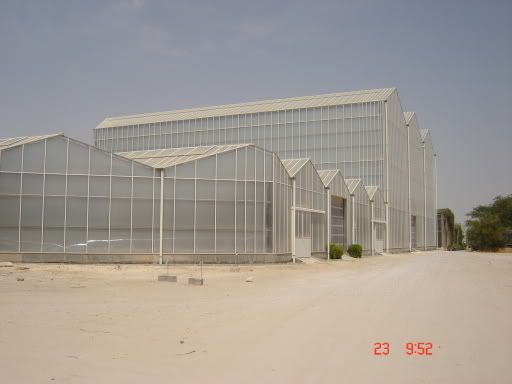
Glass: This has been in use for at least a century in Northern Europe (Holland, England, etc.). Early glasshouses required significant wood and later metal structures to hold small but relatively heavy panes of glass. This reduced incoming light. Modern glasshouses have large panes of glass with reduced framing of stronger materials to increase light levels. Light transmission (PAR) is between 71 and 92 % depending on the type of glass and the estimated lifetime is 25 years or more. However, glass is inflexible, heavy, easily broken (unless tempered) and expensive and many growers are now opting for plastic materials.
Polyethylene: First developed in England in 1938, this flexible, lightweight material is used extensively on hoop or arch style greenhouses because it is easy to work with and inexpensive. A single layer can be used or two layers can be applied with an air layer (maintained by a small fan) in between. This air layer adds insulation from heat and cold and adds structural strength with the double layer polyethylene houses being more stable in areas of high winds or typhoons. Light transmission (PAR) is around 85-87 %. Unfortunately, the estimated lifetime is only 2-4 years, depending on location and quality of the polyethylene.
Polyvinyl chloride (PVC): Another flexible film that has light transmission qualities similar to glass. This material has been used extensively in Japan. While polyethylene sheets can be wide, PVC is narrow which is a disadvantage in covering greenhouses.
Corrugated Fiberglass (also known as fiber reinforced polyester): This is a common greenhouse glazing. It is inexpensive, strong and easy to work with. Light transmission (PAR) is between 60 (double walled) and 88 %. However, it is susceptible to UV light, dust and pollution (hose down or wash periodically), yellows with age and is extremely flammable. The estimated lifetime is 7-15 years, depending on type of fiberglass . .
Acrylic: This glazing material is lightweight, easy to work with and resistant to UV radiation and weather. Light transmission (PAR) is 83 % for double wall and 93 % for single wall. The estimated lifetime is 20 years or more. However, it is easily scratched, has a high expansion and contraction rate, becomes brittle with age, is expensive, and is flammable.
Polycarbonate: This glazing material is lightweight, easy to work with and is resistant to high impacts. Typical light transmission (PAR) is 79 % for double wall and 87 % for single wall. However, recent advances have produced polycarbonates (e.g., “Dynaglas”, a single walled, corrugated material) with light transmission properties equal to or even exceeding glass. The estimated lifetime is 5-10 years, or more, depending on type.Previously, polycarbonate was known to scratch easily and have poor weatherability and UV resistance. However, recent advances in material properties have alleviated some of these earlier problems by coating the outer layer with acrylic.
Wood: Due to increasing cost and availability of more suitable materials, wood is no longer generally used in large commercial greenhouse construction. If used for smaller greenhouses or in areas where other types of framing materials are not available, wood must be treated for protection against decay, especially the sections that come in contact with the soil. Treatments must be non-toxic to plants and animals (Ex: do not use creosote or pentachlorophenol). Chromated copper arsenate (CCA), ammonical copper arsenate (ACA) or other preservatives containing combinations of copper, chromium and/or arsenic are safe to use around plants. Also treat woods with “natural decay properties” such as redwood or cypress, especially in desert or tropical regions.
Reinforced concrete: Usually used for the greenhouse foundation and low walls.
Reinforced concrete and bamboo: In the People’s Republic of China, the concrete has been used as support posts for a frame of bamboo.
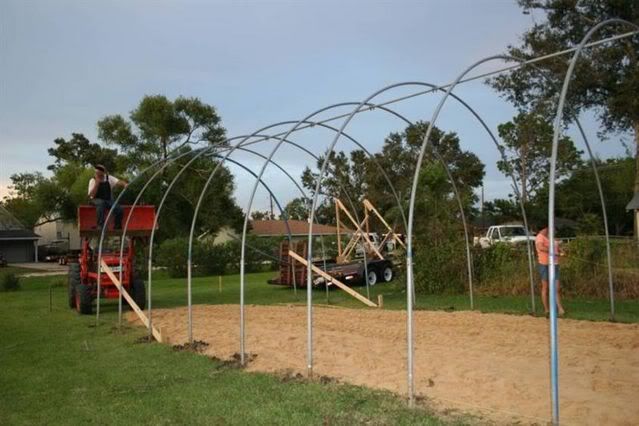
PVC (polyvinyl chloride): Hollow tubes of this plastic material (typical inside diameter of ½ inch) can be used for small scale hoop or arch style greenhouses. These are not necessarily considered “permanent” structures
Electrical conduit: This can also be used, like PVC pipe, for small scale hoop or arch style greenhouses. These are not necessarily considered “permanent” structures.
Air or air tubes: The structures of some greenhouses of the hoop or arch style (covered with flexible polyethylene film) can be maintained solely by air pressure either by inflating the entire greenhouse or by inflating air tubes that act as structural members. This requires air handling equipment, and if the power fails the greenhouse will collapse.
Steel (galvanized): Almost all steel used in greenhouses today is single or double dip galvanized to protect against corrosion. It may be used in conjunction with aluminum. It is usually protected from direct contact with the ground (and subsequent corrosion) by being encased in concrete
.
8. Aluminium: It may be used alone or in conjunction with galvanized steel. It is much lighter than steel but is only about one half the strength of an equally sized steel member. It is usually protected from direct contact with the ground (and subsequent corrosion) by being encased in concrete.
Rear wall window installation on the greenhouse video Contoh Struktur Rumah Lindungan Hujan Rangka Besi G.I di Malaysia
Greenhouse: A framed or inflated structure used for cultivating plants. It is covered with a transparent material that allows for optimum light transmission of the appropriate wavelengths (i.e., photosynthetically active radiation or PAR). It protects against adverse climatic conditions and control of the environment to achieve goals (e.g., opt. yield, etc.). One of the first recorded greenhouses was built during the first century A.D. It was covered with “transparent stone”, probably sheets of mica, to grow cucumbers out of season for the Roman Emperor, Tiberius. A greenhouse must provide protection from adverse “abiotic” conditions such as heat cold rain wind sleet hail snow salt blowing sand NOTE: Structures can also be built to protect plants against “biotic” factors, for example, cages covered with insect or bird netting to protect against insect and bird predation, respectively. However, these structures will not be considered here.
Structural members must be strong enough to prevent structural failure during adverse weather conditions but be kept to a minimum size and number to reduce the amount of shading and to provide for maximum light transmission. Greenhouse structures are rated for certain “design loads” (the load or weight supported by the structure):
Dead Load = the greenhouse framing and everything hanging from it including the glazing (covering), pipes, heaters, fans, pads, shade cloth, motors, support cables AND any hanging crops or baskets in place more than one month.
Live Load = transient greenhouse assembly or repair equipment, people (not swinging from the rafters!) who must climb onto the structure to perform various repairs, cleaning, servicing, etc. AND any hanging crops (e.g., tomatoes, peppers, cucumbers) or baskets in place less that one month.
Wind Load = the load, in pounds per square foot, placed on the exterior of the greenhouse by wind. This will depend on :
The angle at which the wind strikes the greenhouse.
The shape of the greenhouse (height, width, number of bays, etc.).
Whether or not vents, doors, etc. are open or closed.
*NOTE: If a sufficient wind strikes the side of a greenhouse it could rip the roof off! (Local windbreaks – trees – can help.) Depending on the location, a typical “wind load” is 80 mph or 16 lb/ft2. The greenhouse frame needs to be secured to the ground against wind. With permanent structures, anchor the supports in concrete. With temporary structures a cork screw device is used to anchor the greenhouse to the ground. 4. Snow Load = the load, in pounds per square foot, placed on the exterior of the greenhouse by snow accumulation. The type of snow makes a difference:
12 inches of dry snow equals 5 pounds per square foot of load.
3 inches of wet snow also equals 5 pounds per square foot of load.
and 9 inches of wet snow can collapse a greenhouse
When it starts to snow hard – increase the heat in the greenhouse to melt it. Early snow will melt easily. Succeeding snows will slide off. Building Codes:
Each state/country will have its own codes.
Sometimes agricultural buildings will be exempt from the codes or be treated as “special structures”.
*Example: Greenhouses can be built very cheaply in Mexico because Mexico has no building codes. However, these greenhouses may also not be as safe as if they were built to USA code. *Always make sure the builder/contractor is insured .
It looks simple, but that Argus box contains a sophisticated greenhouse climate controller. Each greenhouse had one of these. Talk about expensive! Those big exhaust fans keep the air moving so the little plants can breathe
Rows of greenhouse with individual exhaust fans
As far as greenhouse farmer and Hydroponic/fertigation growers are concern, heating and cooling are obviously a significant part of their operating budget. Any measures that reduce the need for heating and cooling will reduce the costs for these as well, and will therefore increase profit (the bottom line for a commercial grower, schools and even home gardeners!). There are several methods can be outlined to conserve energy in a greenhouse as well as alternatives to “traditional” methods of heating.
Greenhouse orientation: In northern latitudes single bay greenhouses can be oriented east-west to allow maximum light reception in the late fall, winter and early spring. For multiple bay, gutter-connected greenhouses the orientation is usually north-south so that the shadows from the gutters track from west to east across the crop rather than shading the same areas all day. In either case, the rows of plants within the greenhouse should run north-south to optimize equal light to all plants throughout the day.
Windbreaks to save on heating: A wind of only 15 mph can double the heat loss from a greenhouse. A wind reduces the thickness and therefore the insulating effectiveness of the thin air layer (boundary layer) along the greenhouse glazing. A wind will essentially “suck” heat away from a greenhouse faster than if the air was still. Windbreaks, in the form of fences, trees, buildings, etc. can slow the wind and therefore cut heat losses from the greenhouse. Windbreaks are most effective with older, leaky greenhouses or in high wind areas. However, older greenhouses should be upgraded since this will save far more money in heating costs than any windbreak.
Use of double verses single layer glazings: Double layer glazings, with at least a ¼” insulating layer of air in between, can reduce the conductive heat loss by up to 40% over single layer glazings. Using triple layered glazing or, for example, a double layer of polyethylene overglass, can further cut heat loss, but it will also reduce solar radiation, so this is very rarely done.
Structural insulation: Insulating materials can be applied to the foundation of the greenhouse, to the north wall (in the northern hemisphere) and to the walls up to the height of the plants to reduce conductive heat loss. Weather stripping and other insulating materials should be added where ever there are gaps in the structure. This includes around doors and vents and whereglazing panels meet the structural supports. If the glazing material is cracked (ripped polyethylene, broken glass panes or cracked poly acrylic or carbonate) replace immediately to reduce heat loss.
Inflatable tube insulation: Polyethylene tubes (6-18” in diameter) can be hung from the greenhouse ceiling. When inflated they create an effective insulating barrier to heat loss through the ceiling (up to 40%). Make sure the tubes fit snuggly along the walls. Since polyethylene above the crop will reduce light transmission, tube systems have been designed to be retractable or removable during the day. Though effective, these systems are rarely used in commercial operations.
Retractable heat or insulating blanket or curtain: Porous, non-porous and aluminized materials are all used as insulation blankets. The material can be single or multiple layers: more layers giving more insulation. The material, placed between the ceiling and the crop, must be secured along the walls to minimize cold air above falling through onto the crop. These curtains can be used during the day in the summer for shading as well. These retractable curtains are perhaps the most cost effective.
IR coatings on polyethylene films: These infrared barrier films allow heat into the greenhouse during the day (requiring a bit more venting or cooling) but significantly reduce heat loss at night by as much as 30%.
Other insulating methods – experimental: Polystyrene beads have been used by blowing them into the air space between two glazing layers. Energy savings may amount to 60-90% annually. Liquid foam (or soaps) can be blown into the air space between two glazing layers for an energy savings of perhaps as much as 50%. A disadvantage of this is that most foams break down in cold. Unfortunately, neither of these experimental methods are currently practical.
Equipment operation and maintenance: Maintain the heating equipment (check for leaks, valve operation, thermostats, etc.) so that it operates at peak efficiency. Insulate supply and return hot water/steam pipes. Inspect regularly. Choose the most efficient and cost effective fuel: In most places, natural gas.
Solar Heat: This method has gained popularity recently because of its efficiency & also cost effective as to compare to most of other methods mentioned above. This video shows how
In northern latitudes (Canada, England, Holland, etc.) the cost for heating, especially, and cooling a greenhouse for hydroponic can amount to 70 – 85% of the total operating costs. In warmer areas (the Southwest United States, Mexico, Spain, Tropical Asian countries, etc.) the costs can still be around 50% of the total operating costs. Therefore, heating and cooling are obviously a significant part of the operating budget. Any measures that reduce the need for heating and cooling will reduce the costs for these as well, and will therefore increase profit (the bottom line for a commercial grower, schools and even home gardeners!).There are several points to be considered in order to make the greenhouse environment cool and well ventilated for the energy conversation:
Structural considerations: As with heating conservation, insulation and weather stripping can reduce infiltration of hot outside air into the greenhouse which will reduce cooling needs. Damaged glazing materials should also be replaced. Taller greenhouses (16-22 feet, about 5 to nearly 7 meters) are better since hot air will rise away from the crop.
Equipment operation and maintenance: Maintain the cooling equipment so that it operates at peak efficiency.
Passive measures: Energy savings can be realized by using shade cloth or paint.
Learn the basic of how to keep things cool in 'Ventilation And Cooling' , a jam packed minute about the passive and active cooling systems utilised in the University Of Arizona's Hydroponic greenhouse (by the The Control Environment And Agricultural Center or CEAC Web Team). Brought to you via Macromedia Flash.
Ventilating fan & Fog system can reduce the heat in a greenhouse
There are 8 basic needs for the Fertigation method in a modern farming concept. We will cover part of it in this post and will continue on the next post:
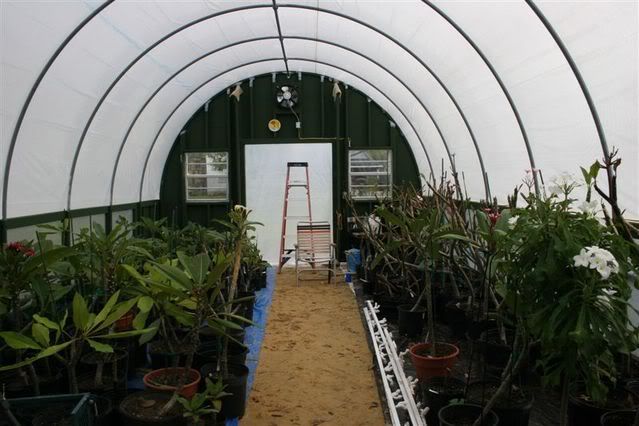
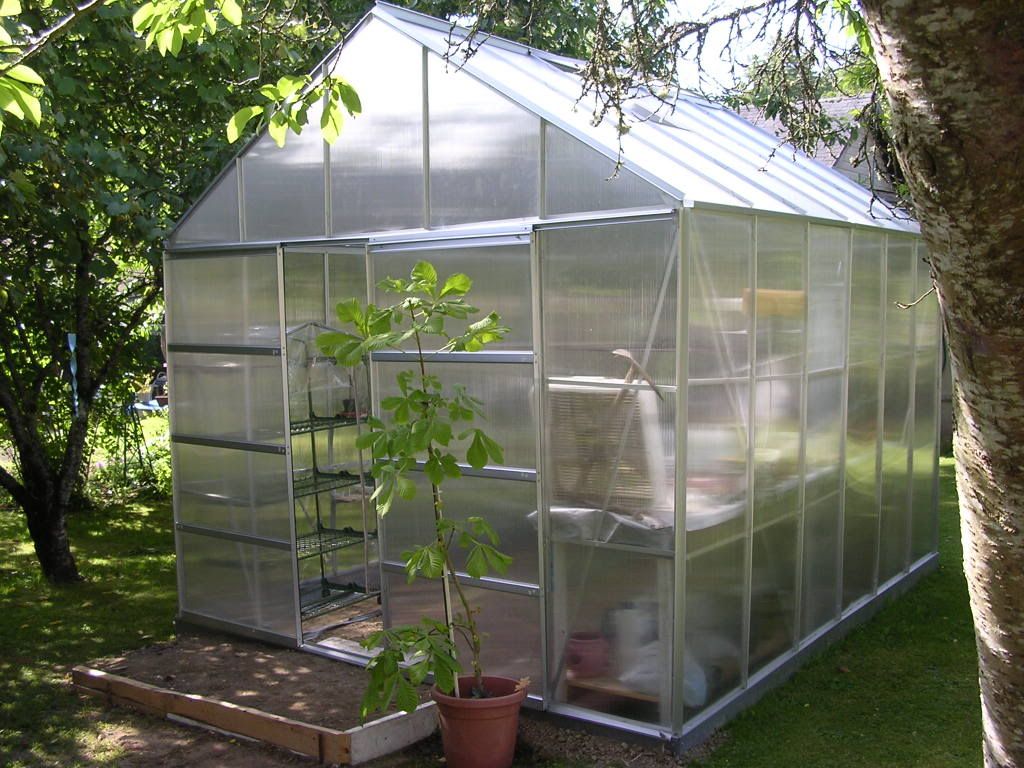
1) Greenhouse- It is advisable to have a curved shape design to withstand strong winds and heavy rain especially for the greenhouse plastic film roofing. The film is secured by a special clip to the structure. The material of the structure can beAluminium, G.I pipe or black pipe. If you want an 'A' shape structure, you can use arcylic or carbonated plastic for the roof. Even though it is much expensive but its durable and last long with a very minimal maintenance needed. It is always used in the West especially countries that have four seasons. The plastic film is cheaper but not long lasting. Even though the plastic can last up to 5 years but after about a year or two, you can start seeing a layer of green fungus on its surface ( especially in a tropical country like Malaysia, Thailand and Indonesia) which can minimise the sunlight for the plant and thus inhibit the plant growth. To get rid of it is very tedious not an easy job. You must also try to prevent the plastic film from getting contact with pesticide, fungicide or any chemicals especially solvents as they might deter the quality. So, you decide what material to use. The important thing is that the sunlight can pass thru the roof. ____________________________________________________________________
Terdapat 8 keperluan untuk penanaman kaedah Fertigasi. Kita akan menjelaskan satu-persatu di dalam post ini dan post2 yang berikutnya:
1) Rumah Lindungan Hujan - Konsep menggunakan rumah lindungan untuk sistem fertigasi ialah untuk mengelakkan air hujan dari mencairkan pembajaan titis yang telah disukat terlebih dahulu. Ini adalah keperluan yang paling utama bagi pertanian berketepatan tinggi bagi mendapatkan hasil yang sekata (uniform) dan mengoptimasikan penggunaan baja. Adalah sangat dicadangkan untuk menggunakan struktur berbentuk 'U' atau melengkung kerana ia lebih tahan dengan tiupan angin yang kuat terutama sekali jika kita menggunakan atap bumbung plastik. Lapisan bumbung plastik ini memang kuat dan ianya di sambungkan kepada struktur rumah dengan menggunakan klip khas. Anda juga boleh menggunakan jaring kalis serangga pada struktur rumah lindungan itu. Bahan struktur rumah sebaiknya dari jenis paip G.I yang tahan karat, teguh dan efektik dari segi kos. Boleh juga menggunakan bahan Aluminium' black pipe atau kayu. Jika anda hendak membina struktur berbentuk 'A' seperti yang kami bina di Benut dan Larkin, anda boleh menggunakan bumbung dari bahan arcylic atau plastik berkarbonat yang kuat walaupun harganya lebih mahal. Menggunakan bumbung kaca sangat tidak sesuai untuk iklim Tropika seperti Malaysia, Indonesia dan Thailand kerana tidak mempunyai musim bersalji. Ia hanya digunakan di Barat. Begitu juga menggunakan bumbung plastik sangat tidak releven di negara yang bersalji. Bumbung plastik lebih murah, namun ianya tidak tahan lama (antara 3 ke 5 tahun). Di Malaysia, harganya dalam lingkungan RM650 untuk segulung greenhouse plastic seberat 50kg. ketebalannya bergantung kepada anda, di antara 0.05mm, 0.15mm atau 0.25mm. Saiz untuk 0.15mm ialah 12' X 300' (untuk 50kg/segulung). Jadi, anda boleh rancang sendiri. Sekiranya hendak membina di atas kawasan tanah tinggi atau yang mempunyai angin lintang yang kuat, haruslah menggunakan yang tebal (0.25mm). Masalah yang timbul dalam penyelenggaraan rumah lindungan hujan antara lain ialah tumbuhnya lapisan kulapok hijau pada bumbung setelah 2 tahun ke atas terutama sekali di negara Tropika yang sering hujan. Jika menggunakan bumbung plastik, agak sukar membersihkannya kerana jika tidak berhati-hati, ia akan mengendur. Lapisan fungus ini akan mengurangkan kadar cahaya matahari untuk pokok di dalam rumah dan menganggu proses Fotosintesis. Anda juga harus mengelakkan bumbung plastik dari terkena racun serangga, racun kulat atau apa sahaja bahan kimia terutamanya solven yang boleh merosakkan kekenyalan bahan plastik itu